
An underwater ROV thruster is the propulsion unit that moves an ROV through water by converting electrical power into thrust. If you are building an ROV or selecting one for the first time, thruster selection usually causes more engineering questions than expected. This article explains what an ROV thruster is, how the main motor designs differ, and what key specifications mean in real underwater applications.
What an underwater ROV thruster actually does?
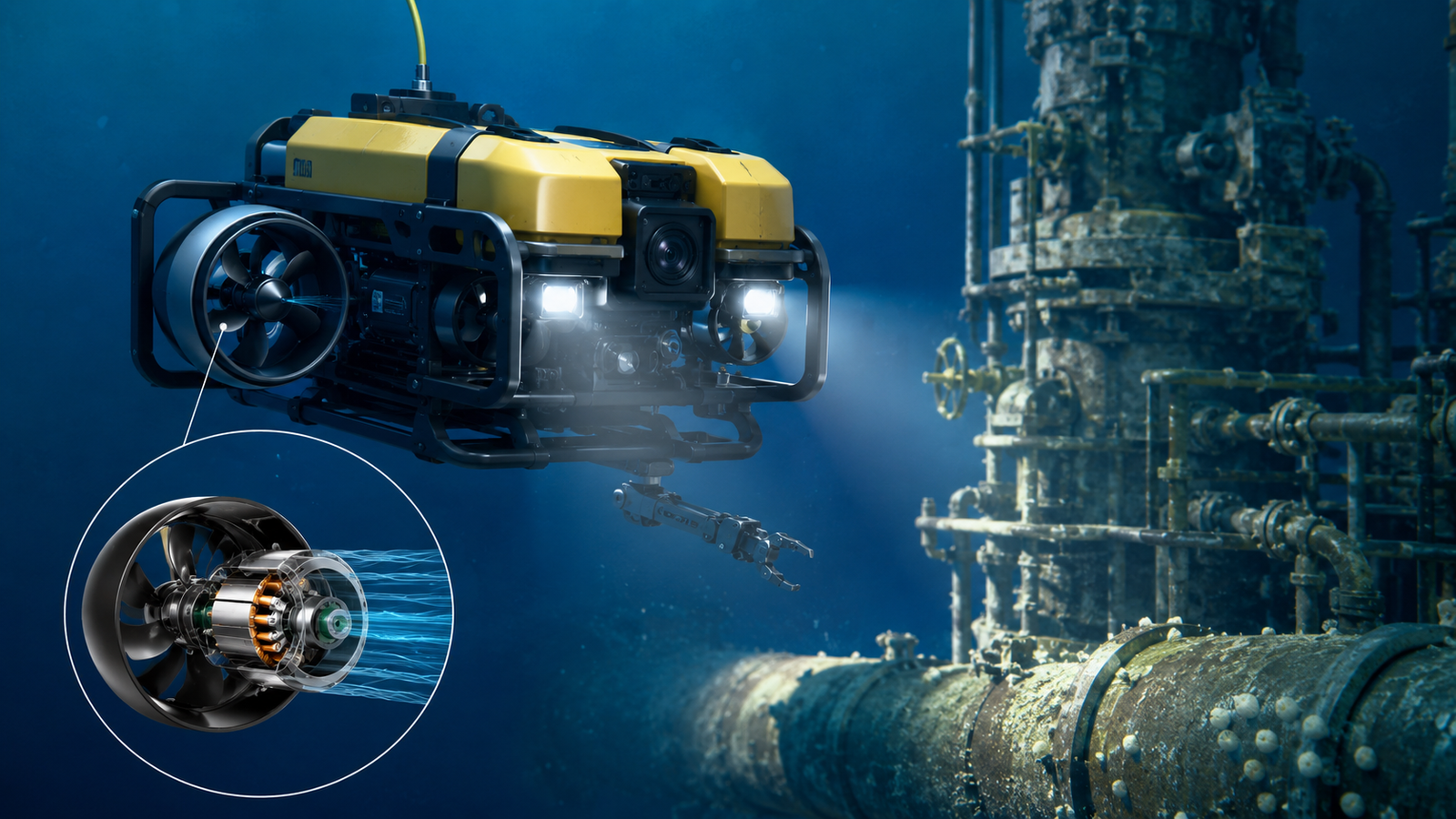
An ROV thruster is an underwater propulsion unit. It converts electrical power into thrust, moving the vehicle through water. Most modern ROV thrusters use a brushless DC motor driving a propeller — the same fundamental technology as a drone motor, but redesigned for continuous operation in a marine environment.
The motor, propeller, and housing are integrated into a single unit. You wire it to a speed controller, and the speed controller takes a signal from your flight controller or onboard computer.
Two Main Motor Designs
Outrunner motors have the outer shell rotating around a fixed inner stator. The magnets are on the outside, the windings are on the inside. This design produces high torque at low RPM, which suits direct-drive propulsion well — no gearbox needed.
Inrunner motors have a fixed outer housing with the rotor spinning inside. They typically run at higher RPM and are more compact for a given power output. Some ROV applications prefer inrunners for their smaller diameter.
Both designs work well underwater. The choice usually comes down to your torque requirements, available space, and what the motor manufacturer can build to your specification.
Flooded vs. Sealed
This is one of the most important design decisions in underwater motor selection.
Sealed motors Sealed motors keep water out entirely. The motor runs in air inside a waterproof housing. For shallow-water or intermittent-use applications, this works well — the design is straightforward and maintenance is simple. The limitation shows up in continuous, high-power operation: heat has nowhere to go, which can restrict sustained performance at depth.
Flooded motors let water flow through the motor itself. The windings and rotor run directly in seawater, which acts as coolant — this is what allows continuous full-power operation without thermal limitation. The stator windings are protected with epoxy encapsulation, and all wetted metal components use corrosion-resistant materials. Done right, it’s a more reliable approach for sustained subsea work than trying to keep water out entirely.
The choice between sealed and flooded comes down to your application. For intermittent or shallow-water work, sealed motors are a practical and well-proven option. For continuous operation at depth — sustained inspection runs, offshore work, long-duration missions — flooded cooling has a clear advantage. Most ROV manufacturers specify based on their actual duty cycle rather than a blanket preference for one design over the other.
Key Specifications Explained
Voltage. ROV systems range from 12V on small hobbyist platforms to 48V or higher on professional inspection vehicles. Higher voltage means less current for the same power, which matters for long tether runs — lower current means less voltage drop over distance.
Depth rating. This is the maximum operating depth the thruster is rated for. It’s determined by the housing design, sealing method, and pressure testing. A thruster rated to 100m will not reliably survive at 300m. Make sure your thruster’s depth rating matches — or exceeds — your operating depth, with appropriate safety margin.
IP rating. IP68 is the standard for continuous submersion. It means the unit is dust-tight and rated for permanent underwater operation at a specified pressure. For any professional ROV application, IP68 is the minimum you should accept.
Thrust. Measured in kilograms-force (kgf) or Newtons. More isn’t always better — oversized thrusters draw more power and may be physically larger than your layout allows. Match thruster size to your vehicle’s weight, drag, and mission requirements.
Winding class indicates the thermal rating of the motor’s insulation. Class F (155°C) is sufficient for most ROV applications. Class H (200°C) is sometimes specified for industrial or offshore work where the motor may run at sustained high load, or where the customer simply prefers a higher safety margin.
Anti-Corrosion Treatment
Seawater is corrosive. Any motor running in it needs materials and coatings that can handle long-term exposure — stainless steel for structural components, corrosion-resistant alloys for the rotor, and protective coating on the stator windings.
For ROVs operating in offshore or industrial environments, anti-corrosion treatment on both rotor and stator is worth specifying explicitly. It’s not always standard.
When Standard Products Don’t Fit
Most catalogue thrusters are designed around specific voltage ranges, depth ratings, and physical dimensions. For a lot of ROV builds, one of these will be a constraint.
If your system voltage is higher than standard products support, your operating depth exceeds catalogue ratings, or your vehicle geometry requires a non-standard shaft or mounting interface — you’re looking at custom development. The key is finding a manufacturer who can work from your specification rather than asking you to redesign around theirs.
LETUMOTOR develops custom underwater motors, ROV thruster motors and underwater propulsion solutions for marine and subsea applications. If standard catalogue thrusters do not match your voltage, depth, size or installation requirements, contact our team to review a custom motor or thruster solution. Contact LETUMOTOR for a Custom ROV Thruster Motor