
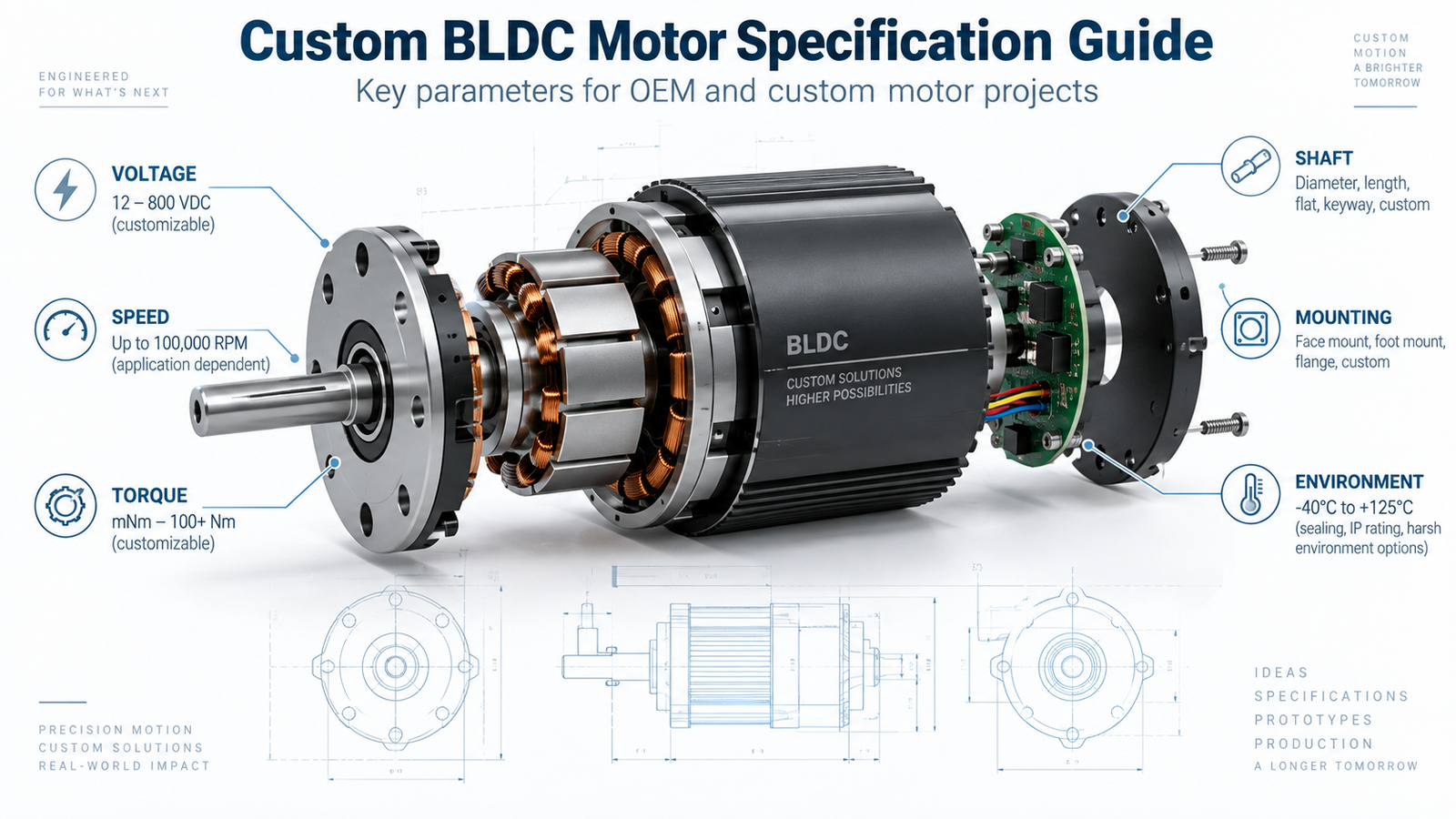
A custom BLDC motor project rarely starts with a perfect specification sheet.
More often, the first message looks something like this:
“We need a 48 V brushless motor around 500 W. Can you make it?”
That is a useful starting point, but it is usually not enough to determine whether an existing motor can be adapted or whether the application needs a more customized design.
We see this quite often in real projects.
A customer may initially focus on voltage and power, but after a few technical questions, the real constraint turns out to be something else:
- the motor diameter cannot exceed 30 mm;
- the existing controller cannot be changed;
- the shaft position is already fixed by the machine;
- the motor must run continuously underwater;
- the mounting holes need to match an existing housing;
- or the required torque at the actual operating speed is very different from what the initial power figure suggests.
Two motors can both be described as “48 V, 500 W” and still be completely different motors in practice.
For a custom BLDC motor, the best place to start is usually not the catalog.
It is the application.
This guide explains what information is most useful when discussing a custom brushless motor project with a manufacturer.
1. Start With the Application, Not the Motor
Before discussing winding, KV or motor dimensions, explain what the motor actually has to drive.
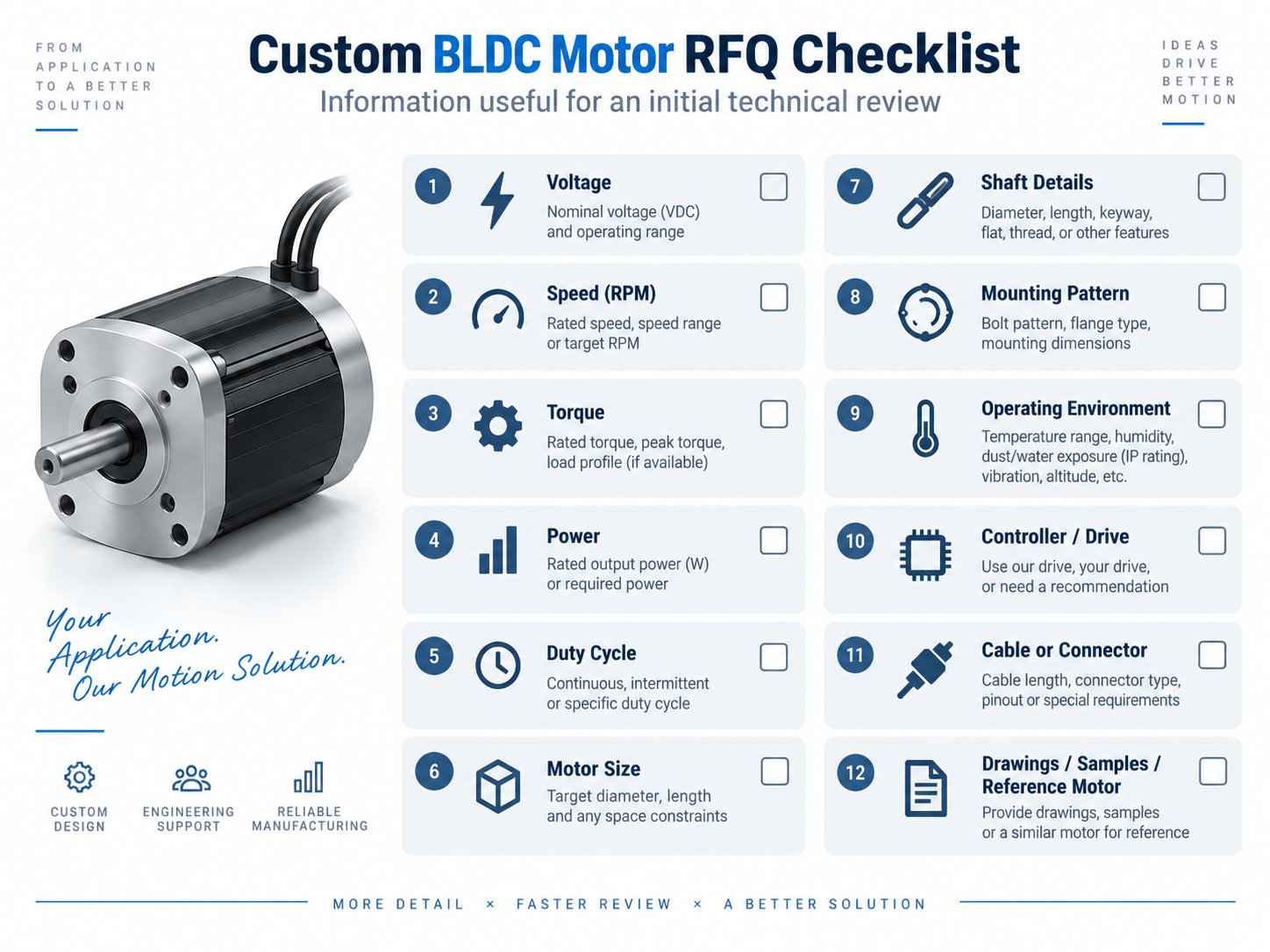
For example:
- a centrifugal pump;
- an underwater thruster;
- a robotic mechanism;
- an industrial actuator;
- a conveyor;
- a blower or fan;
- a rotating tool;
- agricultural equipment;
- automation machinery;
- or another OEM device.
This matters because different applications create very different motor requirements.
A pump may need stable continuous operation for hours.
An actuator may have repeated acceleration, deceleration and short peak loads.
A motor used in an underwater vehicle has to deal with water ingress, corrosion, pressure and thermal behavior.
A motor installed inside a compact machine may be limited more by its mechanical envelope than by its nominal power.
A better first description
Instead of writing:
We need a 300 W motor.
Try:
The motor drives a small centrifugal pump and operates continuously for approximately six hours per day.
Or:
The motor is installed inside an underwater inspection system. The external shaft has separate bearings, so the motor itself sees only low radial and axial loads.
That short explanation can immediately change how the motor is evaluated.
2. Define the Voltage — and the Actual Operating Range
Nominal voltage is normally one of the first parameters supplied.
Typical examples include:
- 12 VDC
- 24 VDC
- 36 VDC
- 48 VDC
But the nominal voltage is only part of the electrical requirement.
It is also useful to know:
- minimum operating voltage;
- maximum operating voltage;
- whether the system uses a battery or regulated DC supply;
- current limitations;
- controller or ESC type;
- whether Hall sensors are required;
- whether sensorless operation is preferred.
For battery-powered equipment, the actual voltage at full charge may be quite different from the nominal battery voltage.
If the controller has already been selected, send its specifications as well.
A motor should be evaluated as part of the complete drive system, not as an isolated component.
3. Give the Required Speed and Torque — Not Only Power
This is one of the most common gaps we see in early enquiries.
A customer provides:
48 V, 500 W
but no operating speed or torque.
The problem is that 500 W at low speed and 500 W at high speed can lead to very different motor designs.
For a useful first review of a custom BLDC motor, provide as much of the following as possible:
- target operating speed;
- continuous torque;
- peak torque;
- startup torque;
- maximum speed;
- continuous power;
- peak power.
A recent example
One recent project started with a requirement for a compact underwater BLDC motor.
Once the mechanical and operating requirements were clarified, the useful specification looked much more like this:
| Parameter | Requirement |
|---|---|
| Voltage | 48 VDC preferred |
| Continuous mechanical output | Approx. 120–150 W |
| Loaded operating speed | Approx. 10,500–11,500 rpm |
| Continuous torque | Approx. 0.11–0.13 Nm |
| Maximum outside diameter | 30 mm |
| Preferred motor length | 40–55 mm |
| Shaft | Ø4 mm |
| Environment | Fresh water |
| Duty | Continuous |
At that point, the discussion was no longer about finding “a 150 W motor.”
It became a much more specific engineering question:
Can a motor meet this torque-speed point inside a 30 mm diameter envelope while operating continuously in water?
That is the kind of information that makes a custom motor review much faster.
4. Describe the Duty Cycle
A motor running for 30 seconds at a time has a very different thermal problem from a motor operating continuously for eight hours.
That is why duty cycle should be discussed early.
Tell the manufacturer whether the motor runs:
- continuously;
- intermittently;
- in repeated start-stop cycles;
- with frequent acceleration and braking;
- at a relatively constant load;
- or with large load changes.
For intermittent operation, a simple description is enough:
Run for 30 seconds, stop for 90 seconds, approximately 300 cycles per day.
For continuous operation:
Continuous operation at the rated load for up to six hours.
Duty cycle affects temperature rise, winding selection and how conservatively the motor needs to be rated.
5. Define the Maximum Motor Size
For many custom BLDC motor projects, physical space becomes the real design constraint.
Useful dimensions include:
- maximum outside diameter;
- preferred diameter;
- maximum total length;
- available installation envelope;
- clearance around the motor;
- fixed housing dimensions.
For example:
Preferred OD is approximately 28 mm, but the absolute maximum is 30 mm. Length can be between 40 and 55 mm.
That immediately tells the manufacturer much more than a power figure alone.
A practical lesson from custom projects
If the motor has to fit inside an existing product, send a drawing early.
A 2D drawing, STEP file or assembly sketch can often eliminate several rounds of email clarification.
In some projects, the first motor recommendation looks electrically suitable but becomes impossible once the actual mounting space is checked.
Mechanical constraints are not a secondary detail.
They are often the starting point.
6. Specify the Shaft Carefully
Shaft geometry is one of the most common mechanical changes in a custom BLDC motor project.
Useful details include:
- shaft diameter;
- shaft length;
- free shaft extension;
- round shaft;
- D-flat;
- keyway;
- thread;
- retaining groove;
- hollow shaft requirement;
- shaft material, where relevant.
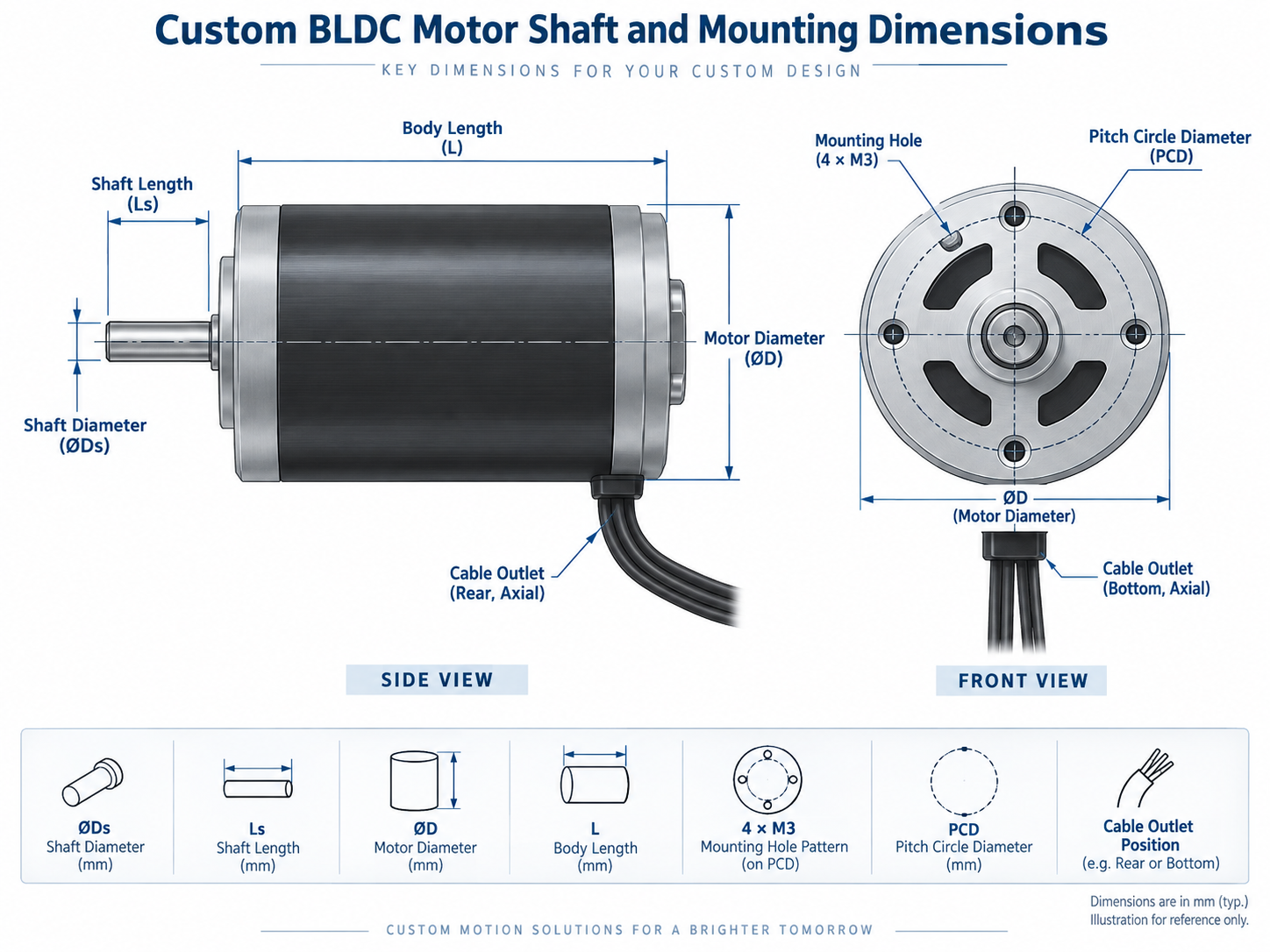
A clear specification might be:
Ø4 mm output shaft with 10 mm free extension. A round shaft is acceptable, with an optional D-flat.
But shaft geometry is only part of the question.
You should also explain what loads the shaft will see.
For example:
- Is the motor directly carrying a propeller?
- Is there a pulley or gear on the shaft?
- Is the motor connected through a coupling?
- Does the external mechanism have its own bearings?
This affects radial and axial bearing loads.
Example
In one compact underwater application, the external shaft was separately supported by its own bearings.
That meant the motor did not need to carry large external radial or axial loads.
This is a small piece of information, but it can materially affect the mechanical design discussion.
7. Include the Mounting Interface
A motor can meet every electrical requirement and still be unusable if it cannot be mounted into the equipment.
Useful mounting information includes:
- number of mounting holes;
- thread size;
- PCD;
- thread depth;
- pilot diameter;
- mounting face;
- front or rear mounting;
- required orientation.
If you prefer to use an existing motor platform, another practical approach is to ask the manufacturer for its standard mounting pattern first.
Sometimes it is easier to adapt the surrounding structure than to redesign the motor unnecessarily.
8. Describe the Operating Environment
For industrial and outdoor applications, environmental requirements can significantly change the design approach for a custom BLDC motor.
Tell the manufacturer if the motor will be exposed to:
- dust;
- rain;
- high humidity;
- fresh water;
- seawater;
- oil;
- chemicals;
- high ambient temperature;
- low ambient temperature;
- elevated pressure;
- frequent washing;
- outdoor weather.
For underwater applications, additional information becomes important:
- working depth;
- maximum pressure;
- fresh water or seawater;
- continuous or intermittent immersion;
- cable outlet direction;
- sealing method;
- housing interface;
- corrosion requirements.
Example: underwater does not mean only “waterproof”
A customer asking for an underwater motor may initially say:
It must be waterproof.
But for engineering review, we still need to know whether this means:
- occasional splash;
- shallow fresh-water immersion;
- permanent immersion;
- seawater operation;
- or operation under significant hydrostatic pressure.
These are not equivalent requirements.
For more detail on this subject, see our article:
Key Design Factors for Waterproof BLDC Motors in Marine Applications
[Internal link to your existing underwater article]
9. Tell the Manufacturer How the Motor Connects to the System
Cable and connector requirements can look minor during early motor selection but become important during final integration.
Useful information includes:
- cable length;
- wire gauge;
- cable outlet direction;
- connector type;
- waterproof connector requirement;
- phase-wire definition;
- Hall sensor connector;
- sensor requirements.
If your equipment already uses a fixed connector, provide the manufacturer and part number.
On very compact equipment, even the cable exit direction can affect whether the motor fits the assembly.
10. Separate Fixed, Preferred and Flexible Requirements
This is one of the most useful things an OEM customer can do.
Customers are usually very good at telling us what they want.
But they do not always tell us which requirements are absolutely fixed.
For example:
48 V is fixed because the controller has already been selected.
Motor OD cannot exceed 30 mm because the housing tooling already exists.
The shaft position and mounting holes cannot change.
The target speed can vary by ±10% if the torque and thermal requirements are met.
These statements are extremely useful.
A good way to structure the project is:
Fixed
Requirements that cannot change.
Preferred
Requirements you would like to keep but can discuss.
Flexible
Parameters the motor manufacturer may optimize.
This helps avoid spending engineering time trying to optimize something that the customer cannot change anyway.
It also tells the motor supplier where there is room to solve the problem.
What Can Actually Be Customized on a BLDC Motor?
Not every project requires a motor to be designed completely from zero.
In many cases, the most practical approach is to begin with an existing motor platform and modify the areas that affect performance or integration.
Depending on the project, customization may involve:
Electrical characteristics
- winding;
- KV;
- voltage matching;
- speed characteristics.
Mechanical interface
- shaft diameter;
- shaft length;
- mounting;
- cable outlet;
- installation interface.
Electrical interface
- wire length;
- connector arrangement.
Environmental adaptation
- waterproofing;
- sealing;
- application-specific protection.
Special mechanical structures
For certain projects, more specialized structures such as hollow-shaft, shaftless or coaxial configurations may also be considered.
The real question is therefore not simply:
“Can this motor be customized?”
A more useful question is:
“Which parts actually need to change for this application?”
Case Example: When Power Was Not the Main Constraint
Consider a hypothetical OEM project where the customer initially asks for:
48 V, approximately 200 W.
At first glance, that sounds straightforward.
But after reviewing the application, we learn:
- maximum motor OD is 32 mm;
- motor length cannot exceed 60 mm;
- the customer already has a controller;
- the motor runs continuously;
- the shaft position cannot move;
- the existing motor overheats after prolonged operation.
Now the project is no longer simply about finding a “200 W BLDC motor.”
The real engineering questions become:
- Can the required operating point be achieved inside that envelope?
- Is the existing winding appropriate for the controller?
- Is there enough thermal margin for continuous operation?
- Can the existing mechanical interface be retained?
This is why custom motor projects should start with application constraints rather than a catalog power rating.
Case Example: Same Power, Different Application
Imagine two customers both requesting a 500 W BLDC motor.
Customer A — Pump
The motor:
- runs continuously;
- operates at a relatively stable speed;
- drives a pump;
- is installed inside industrial equipment.
Important considerations may include:
- continuous torque;
- operating efficiency;
- temperature rise;
- bearing life;
- motor envelope.
Customer B — Automation Mechanism
The motor:
- starts and stops frequently;
- accelerates repeatedly;
- sees short peak loads;
- operates as part of a machine axis.
The important considerations may instead include:
- acceleration torque;
- peak torque;
- control characteristics;
- repeated duty cycle;
- integration with the existing mechanism.
Both customers may initially ask for “500 W.”
But they do not necessarily need the same motor.
Existing Motor Modification or a Deeper Custom Design?
Once the application requirements are understood, the next question is whether an existing platform is close enough.
Modifying an existing platform may be suitable when:
- the motor diameter and length are already close;
- the electromagnetic platform can meet the required operating point;
- the main changes involve winding, KV, shaft, mounting, cable or connector;
- development time needs to be minimized.
A deeper custom design may be needed when:
- the installation envelope is unusual;
- the required torque-speed point is far from available platforms;
- the motor requires a special mechanical structure;
- the environment creates unusual sealing or material requirements;
- the motor must be closely integrated into the customer’s mechanism.
A custom motor supplier should not automatically recommend a completely new design.
Sometimes a relatively small modification solves the problem.
Sometimes it does not.
The purpose of the initial engineering review is to find out which situation applies.
A Practical Custom BLDC Motor RFQ Checklist
If you are preparing an enquiry, the following information is normally enough for an initial technical review.
| Item | Example |
|---|---|
| Application | Underwater inspection robot |
| Nominal voltage | 48 VDC |
| Voltage range | 42–54 VDC |
| Continuous power | 150 W |
| Target speed | 10,500–11,500 rpm |
| Continuous torque | 0.11–0.13 Nm |
| Duty cycle | Continuous |
| Maximum OD | 30 mm |
| Preferred length | 40–55 mm |
| Shaft | Ø4 mm |
| Shaft extension | 10 mm |
| Mounting | Existing standard holes preferred |
| Radial / axial load | Low; external shaft separately supported |
| Environment | Fresh water |
| Controller | Existing 48 V controller |
| Special requirement | Stationary outer motor housing |
| Drawing | Available |
You do not need to know every parameter before contacting a motor manufacturer.
If some information is still unknown, send what you already have.
A clear description of the application usually tells us what needs to be clarified next.
What If You Only Have a Sample Motor or Drawing?
That is also a normal starting point.
Many OEM projects begin with:
- an existing motor;
- a competitor or reference motor;
- a 2D drawing;
- a STEP file;
- a prototype machine;
- a partial datasheet.
Sometimes the customer knows exactly what is wrong with the current motor.
For example:
The motor fits mechanically, but we need more continuous torque at the same diameter.
Or:
The electrical performance is acceptable, but the shaft and mounting interface need to change.
Or:
The motor reaches the required speed, but the temperature becomes too high during long continuous operation.
These are all valid starting points for a custom motor discussion.
You do not need to redesign the entire machine before talking to the motor supplier.
Better Input Usually Means Faster Evaluation
A custom BLDC motor project does not have to begin with a perfect specification.
But a few pieces of information make the first review much more efficient:
Application. Voltage. Speed. Torque. Duty cycle. Size. Shaft. Mounting. Environment.
If you also have:
- a drawing;
- a reference motor;
- a sample;
- controller information;
- or existing test data;
include them.
The goal is not to force every project into a standard catalog motor.
It is to understand whether an existing motor platform can be adapted efficiently or whether the application genuinely requires a deeper level of customization.
Have a Motor That Does Not Fit a Standard Catalog?
If you are developing an OEM product, send us:
- your application;
- voltage;
- target speed and torque;
- size limits;
- duty cycle;
- operating environment;
- drawing or reference motor, if available.
LETUMOTOR can review the basic requirements and determine whether an existing BLDC motor platform can be modified or whether a more customized solution should be considered.
Send Your Motor Requirements →
FAQ
If you are preparing a custom BLDC motor RFQ, the following information is normally enough for an initial technical review.
At minimum, provide the application, voltage, target speed, torque or power requirement, approximate motor dimensions and duty cycle. Mechanical drawings and environmental requirements are also very useful.
Can an existing BLDC motor be modified instead of developing a completely new motor?
In many projects, yes. If an existing motor platform is close to the required operating point and mechanical envelope, modifications to the winding, KV, shaft, mounting, cable or connector may be sufficient.
Can you customize the motor shaft and mounting dimensions?
Shaft dimensions, shaft features and mounting interfaces are common customization areas in OEM motor projects, subject to the motor platform and engineering feasibility.
What should I provide for an underwater BLDC motor project?
In addition to voltage, speed and torque, provide water type, operating depth or pressure, immersion duration, cable outlet requirements, housing interface and corrosion considerations.
What if I do not know the exact torque requirement?
Provide the application, operating speed, load information and any existing motor data you have. These details can help determine what additional information is needed for evaluation.