
Underwater Thruster Motors: Inrunner vs Outrunner Selection Guide
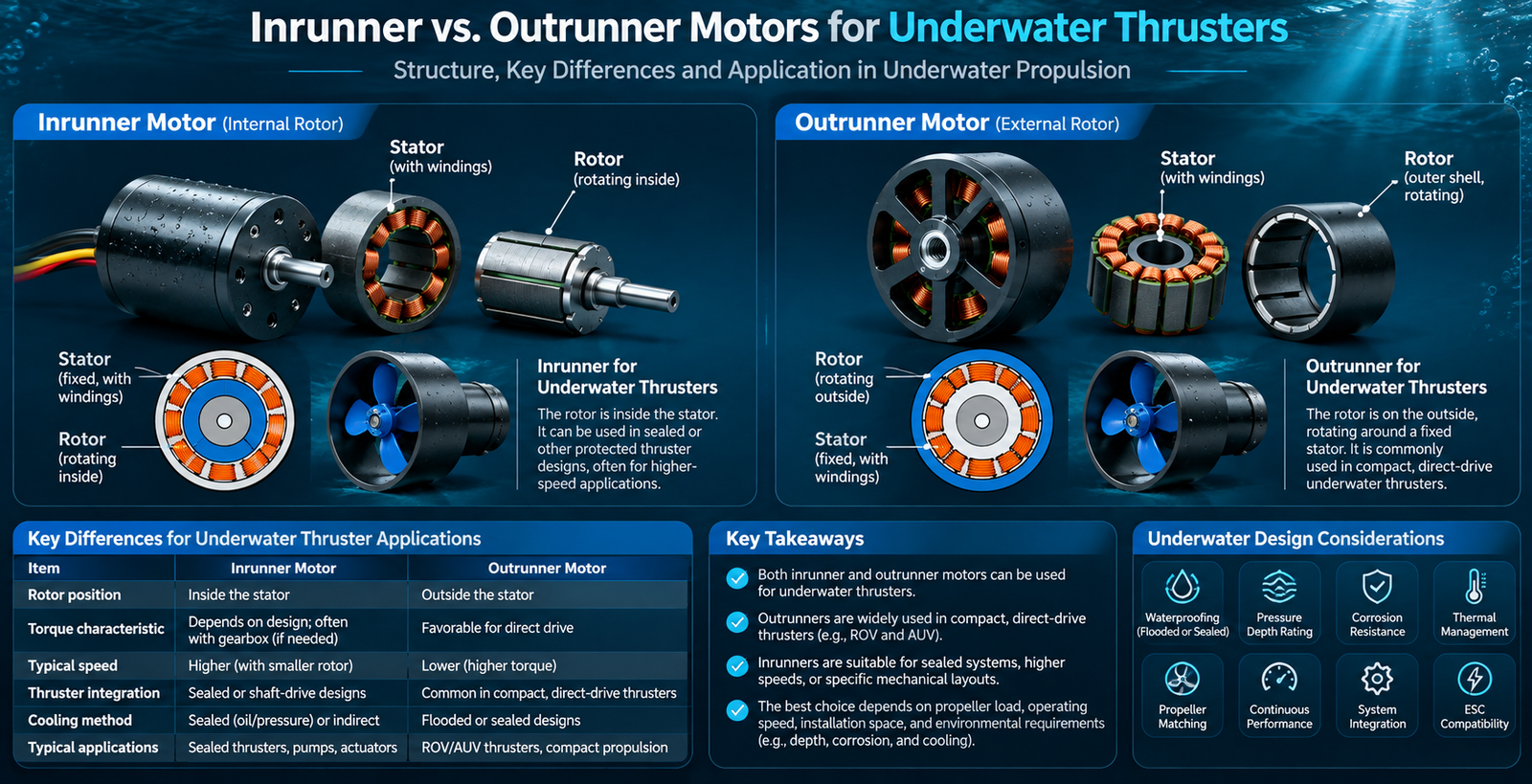
Underwater thruster motor selection is a critical part of designing reliable ROVs, AUVs, marine inspection robots, and underwater cleaning systems. Choosing between an inrunner and an outrunner BLDC motor affects torque, speed, cooling, mechanical integration, and long-term underwater reliability.
In this guide, we compare seven key factors to help engineers and OEM manufacturers choose a suitable motor architecture for their underwater propulsion systems.
The motor must deliver sufficient torque to drive the propeller, operate efficiently at the required voltage, tolerate the underwater environment, and fit within the propulsion assembly.
Two common brushless motor architectures are inrunner and outrunner BLDC motors.
Outrunner motors are frequently used in compact, direct-drive underwater thrusters. However, inrunner motors are also suitable for certain underwater propulsion and drive systems.
The right choice depends on the complete propulsion architecture—not simply whether the rotor is inside or outside the stator.
This guide explains how the two motor types compare and what underwater equipment manufacturers should evaluate before selecting a motor supplier.
1. Understanding Inrunner and Outrunner Motors
Both inrunner and outrunner BLDC motors use electromagnetic forces to produce rotation.
The difference lies in the rotor arrangement.
Inrunner Motor
An inrunner motor has an internal rotating rotor surrounded by a stationary stator.
The output shaft is connected to the inner rotor.
This arrangement is often suitable for conventional shaft-drive systems, higher-speed operation, and motor installations inside a protected housing.
Outrunner Motor
An outrunner motor has a stationary inner stator and an external rotating rotor.
The larger rotor radius can offer useful torque characteristics, particularly for direct-drive applications.
In certain underwater thruster designs, the propeller is attached directly to the rotating outer rotor assembly.
This can reduce the need for additional transmission components.
However, neither configuration is inherently waterproof or pressure-resistant.
2. Why Are Outrunner Motors Common in Underwater Thruster Designs?
Many compact underwater thrusters use brushless outrunner motors because their mechanical arrangement works well with direct propeller drive.
There are several reasons for this.
Direct-Drive Torque
An underwater propeller requires sufficient torque at its intended operating speed.
Outrunner geometry can help designers achieve suitable torque within a compact motor envelope.
A direct-drive system can eliminate a mechanical gearbox, reducing part count and avoiding gearbox losses.
However, direct drive does not eliminate the need to match the motor’s torque-speed characteristics to the propeller load.
Compact Propulsion Assembly
An outrunner motor can be integrated into a compact thruster assembly.
Depending on the design, the rotating motor structure can connect directly to the propeller.
This may reduce the number of mechanical transmission components.
Compatibility With Flooded Motor Designs
Some underwater outrunner motors operate with water flowing through the motor.
One established commercial example is the Blue Robotics T200 thruster, which uses a three-phase brushless outrunner design with encapsulated windings and protected magnetic components.
Its flooded arrangement allows water to cool the motor and lubricate the specified bearing surfaces.
This is one example of an underwater motor architecture—not a feature automatically shared by all outrunner motors.
A conventional drone outrunner should never be assumed suitable for seawater immersion without an appropriate underwater design and validation.
3. Can Inrunner Motors Be Used in Underwater Thrusters?
Yes.
Inrunner motors can be used in underwater propulsion systems, particularly where the mechanical arrangement favors a conventional shaft-output motor or a protected motor compartment.
An inrunner motor may be installed inside a sealed enclosure, with mechanical power transmitted to a propeller through an output shaft.
Depending on the propulsion design, the system may incorporate:
- Mechanical shaft seals
- Magnetic couplings
- Oil-filled pressure-compensated housings
- Specially designed subsea motor assemblies
Each approach introduces different engineering considerations.
For example, a rotating shaft passing through a sealed housing requires an appropriate sealing solution.
A magnetic coupling may avoid a direct rotating shaft penetration but introduces its own design constraints, including torque capacity and potential losses.
Inrunner configurations can also be useful for underwater pumps, actuators, and specialized marine machinery.
Therefore, an outrunner should not automatically be selected for every underwater application.
4. Inrunner vs. Outrunner: Underwater Thruster Comparison
| Selection Factor | Inrunner Motor | Outrunner Motor |
|---|---|---|
| Rotor configuration | Internal rotating rotor | External rotating rotor |
| Direct propeller drive | Possible | Common in compact thrusters |
| Torque characteristics | Depends on motor design; gearing may be useful | Favorable for many direct-drive designs |
| High-speed operation | Often advantageous | Application-dependent |
| Flooded operation | Possible with a suitable subsea design | Used in established flooded thruster designs |
| Sealed installation | Common design option | Also possible |
| Mechanical integration | Conventional shaft interface | Can integrate rotating outer shell and propeller |
| Cooling | Depends on housing and heat transfer | Depends on stator heat path and water exposure |
| Corrosion resistance | Requires marine-specific design | Requires marine-specific design |
Neither architecture guarantees superior efficiency, maximum thrust, or greater depth capability.
These characteristics must be evaluated at the complete thruster-system level.
5. Torque, RPM, and Propeller Matching
A common motor-selection mistake is choosing a motor based only on its voltage, KV rating, or maximum electrical power.
In an underwater thruster, the motor must be matched to the propeller.
A propeller’s torque requirement generally increases as rotational speed rises. Its loading also depends on diameter, pitch, blade geometry, duct design, and operating conditions.
A motor may spin successfully without a propeller but draw excessive current when connected to a heavily loaded propeller.
Motor KV Is Not Thrust
KV describes the approximate no-load motor speed per volt.
For example, a motor’s KV rating helps estimate its unloaded rotational speed at a given voltage.
It does not directly tell engineers how much underwater thrust the motor will produce.
Actual thrust depends on the complete combination of:
- Motor characteristics
- Propeller geometry
- Operating voltage
- Available current and controller limits
- Water flow and installation conditions
For this reason, OEM thruster selection should rely on measured thrust and power data rather than motor KV alone.
Continuous Performance Matters
An underwater inspection robot may operate for extended periods.
A high peak-power specification is not sufficient if the motor cannot sustain the intended load without overheating or exceeding the controller’s current limit.
Engineers should review the intended continuous operating point, duty cycle, and thermal conditions.
6. Waterproofing: Flooded Motors vs. Sealed Motors
This is one of the most important differences in underwater motor system design.
Inrunner and outrunner describe motor geometry. Flooded and sealed describe how the motor is protected from the surrounding water.
These are separate engineering decisions.
Flooded Motor Design
In a flooded motor, water is allowed to enter designated internal spaces.
Critical electrical components must be properly insulated, encapsulated, or otherwise protected.
Metal components must also withstand the intended water environment.
Potential advantages include direct water cooling and avoiding some conventional shaft-sealing arrangements.
However, flooded operation introduces challenges involving material compatibility, corrosion, deposits, debris, and bearing wear.
Sealed Motor Design
A sealed motor system keeps surrounding water away from the protected motor interior.
The enclosure and seals must be designed for the intended pressure and service conditions.
If the motor drives an external propeller through a shaft, the shaft penetration must also be addressed.
Sealed architectures may be appropriate when the system requires protected internal components or a particular mechanical arrangement.
What About IP68?
An IP68 rating alone does not establish that a motor is suitable for every underwater depth or for long-term seawater operation.
The tested immersion conditions, pressure, duration, and environmental requirements must be specified.
A motor intended for shallow freshwater use should not automatically be considered suitable for deep seawater deployment.
7. Seawater Corrosion and Motor Materials
Seawater introduces additional challenges compared with many dry industrial applications.
Material selection can affect both motor performance and service life.
Important areas include:
Permanent magnets: Magnetic components may require appropriate coatings or encapsulation to prevent corrosion.
Stator windings: Electrical insulation must withstand the intended exposure and operating conditions.
Bearings and bushings: Materials must be selected for the expected load, lubrication method, debris exposure, and water environment.
Shafts and fasteners: Corrosion resistance and material compatibility are essential, particularly where dissimilar metals may create galvanic corrosion risks.
Cable exits and connections: The complete cable assembly must be suitable for its exposure and pressure requirements.
A motor that performs well during a short freshwater test may still require additional verification before use in seawater.
8. Underwater Thruster Performance Testing: What Should OEM Buyers Check?
For OEM buyers, reliable test data is often more useful than a theoretical claim about motor efficiency or power.
A practical thruster evaluation should include the following.
| Test Item | What It Helps Verify |
|---|---|
| Forward static thrust | Propulsion force in one direction |
| Reverse static thrust | Reverse maneuvering capability |
| Voltage and current | Electrical operating requirements |
| Input power | Power consumption at different operating points |
| Thrust efficiency | Thrust produced relative to electrical input |
| Continuous running | Performance under sustained operation |
| Pressure testing | Suitability for specified depth conditions |
| Corrosion evaluation | Material behavior in the intended environment |
| ESC compatibility | Starting, reversing, and speed-control behavior |
| Mounting dimensions | Integration with the vehicle structure |
For meaningful comparisons, test conditions should be consistent and documented.
For example, a thrust comparison should identify the operating voltage, measurement method, controller configuration, and relevant installation conditions.
Manufacturers should distinguish tested performance from calculated or proposed specifications.
9. Choosing a Motor for Your ROV or AUV Project
Motor selection should begin with the requirements of the underwater vehicle.
Small Observation ROVs
For compact observation or inspection ROVs, manufacturers may prioritize low weight, manageable power consumption, compact dimensions, and reliable bidirectional thrust.
A small direct-drive outrunner thruster may be suitable, provided its measured performance matches the vehicle requirements.
Underwater Cleaning Robots
Underwater cleaning systems may require propulsion for navigation, station keeping, or maintaining contact with a working surface.
The motor selection depends on whether the equipment uses conventional propellers, suction systems, wheels, tracks, or another drive arrangement.
Not every underwater cleaning robot uses a conventional thruster.
AUVs and Specialized Marine Vehicles
AUV propulsion may emphasize energy efficiency at sustained cruising conditions, acoustic behavior, mechanical integration, and mission duration.
Both inrunner and outrunner architectures should be evaluated according to the complete propulsion system.
Custom Underwater Actuators
For underwater tools, robotic joints, and specialized mechanisms, the required output may be torque rather than propeller thrust.
In these projects, motor selection should consider continuous torque, gearing, position feedback, sealing arrangement, and duty cycle.
10. When Does an OEM Manufacturer Need a Custom Underwater Motor?
An off-the-shelf thruster is convenient when its performance and dimensions match the application.
However, a custom motor may be required when the project involves:
- Nonstandard motor diameter or length
- Specific voltage and torque requirements
- Unusual shaft or mounting geometry
- A customer-designed propeller or thruster housing
- Particular seawater, pressure, or operating conditions
- A need to integrate the motor into an existing mechanical assembly
For an underwater thruster manufacturer, selecting the right motor supplier involves more than comparing motor prices. Important considerations include manufacturing consistency, customization capability, verified performance, sample lead time, and long-term supply reliability.
Working with a custom BLDC motor manufacturer can help OEM developers evaluate motor designs for their specific thruster assemblies without redesigning every component of the propulsion system.
For companies that design their own underwater thrusters, sourcing a custom motor may be an alternative to purchasing a complete thruster assembly.
The customer can retain its own propeller, duct, and mechanical design while working with a motor manufacturer on the electromagnetic and mechanical requirements.
However, any changes to the motor or thruster assembly may require additional testing.
11. Underwater Motor and Thruster OEM Manufacturing With LETUMOTOR
LETUMOTOR develops and manufactures brushless motors and underwater motor solutions for OEM applications.
Our work includes underwater motor development and customized propulsion-related motor designs.
For customers developing their own thrusters, we can review the feasibility of motor-only manufacturing or customization according to the required mechanical dimensions and electrical characteristics.
For customers seeking a complete propulsion assembly, we can discuss existing designs and project-specific development requirements.
Electronic speed controllers and other supporting components are selected according to project requirements and may be sourced from external suppliers.
Actual motor performance, environmental ratings, depth capability, and complete system compatibility are subject to the specific design and validation results.
We recommend starting with the customer’s application requirements or reference drawings before discussing an appropriate motor solution.
12. Frequently Asked Questions
Is an outrunner motor always better for an underwater thruster?
No. Outrunner motors are common in compact direct-drive thrusters, but inrunners can be suitable for sealed propulsion systems and specialized underwater machinery.
Can a drone outrunner motor operate directly in seawater?
Not without a suitable underwater design. Conventional drone motors may lack the required insulation, corrosion protection, bearing materials, and environmental validation.
Does a lower-KV motor always generate more underwater thrust?
No. KV alone cannot determine thrust. Propeller geometry, available torque, operating current, speed, and system efficiency must also be considered.
Is a flooded motor suitable for deep water?
A properly engineered flooded motor can be pressure-tolerant, but its actual depth capability must be validated. Flooded construction alone is not proof of a particular operating depth.
Can an ROV manufacturer purchase only the motor instead of a complete thruster?
Yes. Some manufacturers design their own propellers, ducts, and propulsion housings and seek motor manufacturing partners.
Compatibility and environmental suitability must be evaluated for the complete assembly.
Conclusion
Both inrunner and outrunner BLDC motors can be used in underwater propulsion systems.
Outrunners are commonly selected for compact direct-drive thrusters because of their torque and packaging characteristics.
Inrunners remain viable for systems requiring different shaft arrangements, high-speed operation, or protected motor installations.
For an ROV or AUV manufacturer, the best solution depends on propeller loading, continuous performance, operating voltage, installation space, environmental exposure, and validated reliability.
The goal is not simply to choose an inrunner or outrunner motor. It is to select a motor architecture that meets the requirements of the complete underwater propulsion system.
Looking for a Custom Underwater BLDC Motor or Thruster Manufacturing Partner?
LETUMOTOR supports underwater motor development and OEM manufacturing projects.
Whether you are designing a new underwater thruster or looking for a custom motor to integrate into your own propulsion system, our team can review your requirements.
Please share:
- Application: ROV, AUV, underwater tool, or other equipment
- Operating voltage
- Required torque, RPM, or thrust target
- Motor dimensions or reference drawings
- Intended operating depth and water environment
- Prototype quantity and expected production volume
We can discuss technical feasibility, available design options, and the next steps for engineering evaluation.
Contact LETUMOTOR
Email: hello@letumotor.com