
How to Select a Submersible BLDC Motor for Pool & Spa Systems
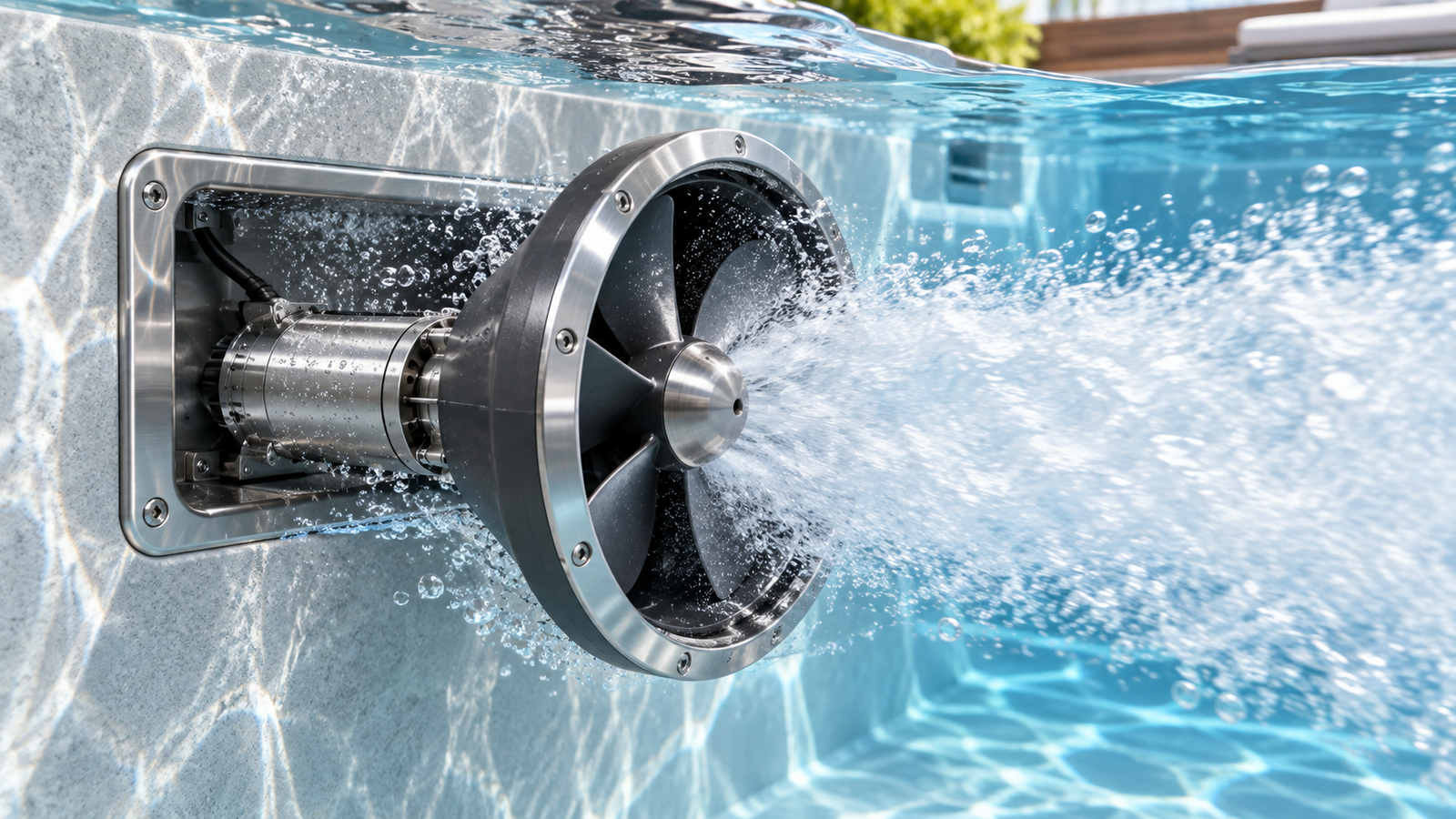
If you are developing a swim spa, counter-current swimming system or pool propulsion unit, selecting the motor can look more complicated than it really is.
You need a motor that works underwater. It has to fit the available space, drive the existing propeller or impeller, deliver enough torque and survive the actual pool environment.
But in many projects, you do not need to design a completely new underwater motor from scratch.
A more practical approach is to start with a proven BLDC motor platform and customize only the parts that matter for your equipment.
That may include:
- winding and operating voltage
- output shaft
- housing material
- waterproof structure
- cable length and outlet
- mounting dimensions
For an OEM pool or spa manufacturer, this can reduce development time, cost and technical risk considerably.
Quick Answer: What Should You Check When Choosing a Submersible BLDC Motor?
For most pool, swim spa and water propulsion applications, start with six questions:
- What voltage and power do you need?
- What RPM and torque does the propeller require?
- How deep will the motor operate, and in what type of water?
- How much installation space is available?
- What shaft or propeller interface must the motor match?
- Will the motor run intermittently or continuously?
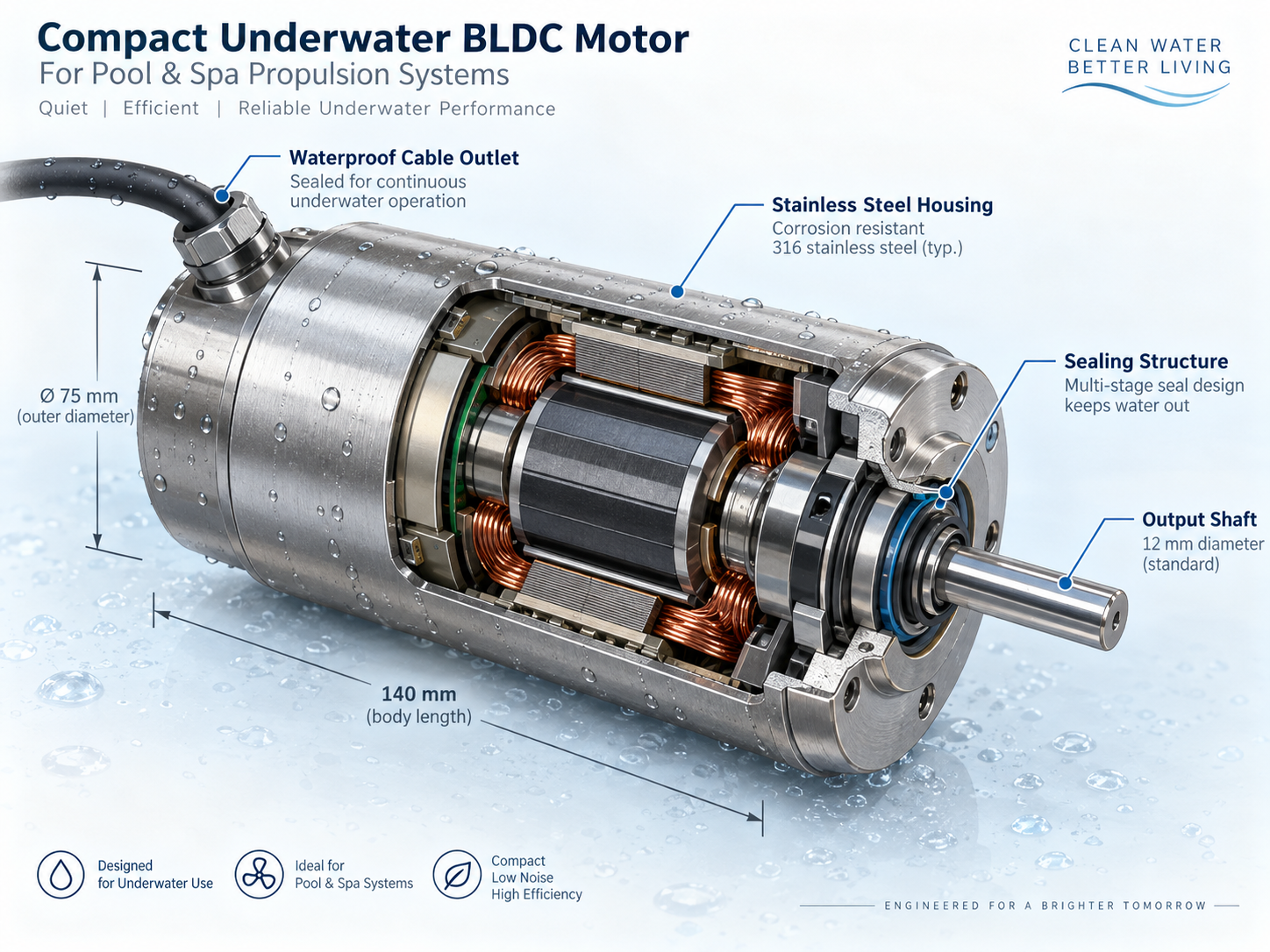
If you already have an existing motor, send the nameplate, drawing or a few photos.
In many cases, that is enough for a motor supplier to determine whether an existing BLDC platform can be adapted.
Why Use a BLDC Motor in Pool and Swim Spa Equipment?
BLDC motors are increasingly used in applications where manufacturers want longer service life, speed control and lower maintenance compared with traditional brushed DC motors.
Because a brushless motor has no mechanical brushes to wear out, it can be a good fit for equipment that operates frequently or for relatively long periods.
Typical applications include:
- swim spas
- counter-current swimming systems
- pool propulsion systems
- aquatic fitness equipment
- spa equipment
- water circulation modules
- compact underwater propulsion units
A BLDC motor also gives equipment manufacturers more flexibility in controlling speed.
That can be useful in a swim spa, for example, where users may want different water-flow levels rather than a single fixed operating speed.
Can You Replace a Brushed Pool Motor with a BLDC Motor?
Usually, yes.
But this is where one of the most common mistakes happens.
A manufacturer may have an existing 500W brushed motor and start looking for any 500W BLDC motor as a replacement.
Unfortunately, power alone does not tell you whether the new motor will work.
You also need to check:
- operating RPM
- torque
- shaft dimensions
- controller
- mounting space
- actual propeller load
Two motors with the same rated power can behave very differently once they are connected to the same propeller.
So when replacing a brushed motor with BLDC, the goal should not simply be:
Find another motor with the same wattage.
The better question is:
Can we reproduce the required water-flow performance while keeping the existing mechanical system?
That is a much more useful starting point.
RPM and Torque Matter More Than Wattage Alone
For a pool propulsion motor, maximum RPM is not always the most important specification.
Many swim spa and counter-current systems need a combination of:
controlled speed + sufficient torque + stable operation under load
If the motor spins too fast but does not have the right torque characteristics, it may not perform correctly with the existing propeller.
Useful information includes:
- original motor RPM
- target operating RPM
- nominal torque
- propeller diameter
- propeller pitch
- actual running current, if available
If you do not have all of these numbers, that is fine.
The existing motor specification and propeller dimensions can often provide a good starting point.
The Output Shaft Is Often Easier to Customize Than the Entire Machine
Mechanical fit is one of the biggest concerns when replacing a motor in an existing pool or spa product.
Fortunately, the output shaft is also one of the most common customization points.
Depending on the motor platform, shaft customization may include:
- shaft diameter
- shaft length
- thread
- keyway
- D-cut
- flat
- propeller mounting interface
This means an equipment manufacturer may be able to keep the existing propeller and product structure rather than redesigning the whole system around a standard motor.
Whenever possible, we prefer to adapt the motor to the equipment, not force the customer to redesign the equipment around the motor.
Is an IP68 BLDC Motor Enough for a Swimming Pool?
IP68 is important, but it does not answer every question about a real underwater application.
An IP68 BLDC motor used in a swimming pool may still need to deal with:
- continuous immersion
- chlorinated water
- saltwater
- elevated water temperature
- repeated operating cycles
- long running periods
So before choosing the sealing structure and housing material, it helps to know:
- maximum operating depth
- whether the motor remains submerged
- water temperature
- chlorine or salt exposure
- typical operating time
A shallow pool application and a deep-water propulsion application may both use the term “IP68”, but they are not necessarily the same engineering problem.
For pool and spa equipment, the actual operating environment matters more than the IP number alone.
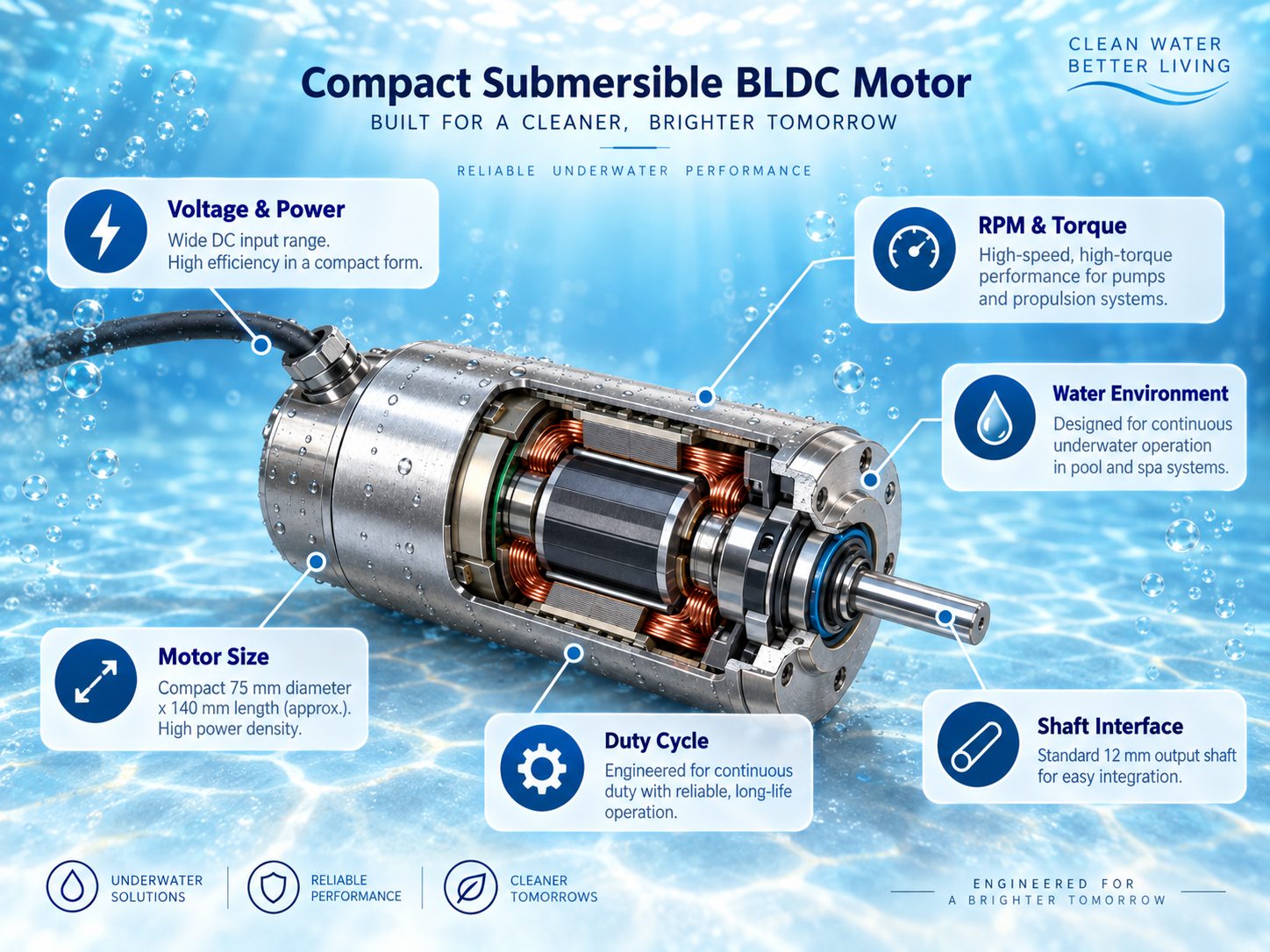
Does a Pool Motor Need 316L Stainless Steel?
Not always.
316L stainless steel is often considered for underwater equipment because of its corrosion resistance, particularly when chlorine or salt is involved.
However, it is not automatically the best choice for every pool motor.
Material selection should depend on the actual application, including:
- water chemistry
- chlorine level
- salinity
- operating temperature
- exposure time
- expected service life
- cost target
For some applications, another stainless steel grade or a suitable surface treatment may already meet the requirement.
The practical approach is:
Use the material the application needs, rather than simply specifying the highest-cost material available.
What About Continuous-Duty Swim Spa Motors?
This is especially important for swim spas and counter-current swimming systems.
A motor that runs for five minutes at a time has a very different thermal requirement from one that may operate for an hour or longer.
For continuous-duty applications, we normally pay attention to:
- continuous current
- motor temperature
- actual propeller load
- controller matching
- cooling conditions
Being submerged in water can help remove heat from the motor housing, but it does not automatically mean every underwater motor can run continuously at maximum load.
The final motor should still be tested under conditions reasonably close to the real equipment.
If the base BLDC platform is already close to the required specification, this is usually a matter of matching and validation, rather than completely redesigning the motor.
When Do You Actually Need a Custom Pool Propulsion Motor?
Not every project needs a fully custom motor.
A standard or lightly modified BLDC platform may be enough when:
- voltage is already close
- motor diameter fits
- power range is suitable
- only the shaft needs modification
- cable or housing needs minor changes
More extensive customization may be needed when:
- installation space is extremely limited
- the required RPM or torque is unusual
- the shaft interface is unique
- the motor must work in a demanding water environment
- an existing brushed motor must be replaced without changing the surrounding equipment
The key is to identify what actually needs customization.
There is little reason to redesign the complete motor if an existing platform already solves 80–90% of the problem.
A Typical Custom Submersible BLDC Motor Project
In practice, a pool or spa motor project can be fairly straightforward.
Step 1: Review the Application
We start with the basics:
- application
- voltage
- power
- target RPM
- operating depth
- installation space
If there is an existing motor, we review that as well.
Step 2: Match the Closest BLDC Platform
Rather than immediately starting a new design, we look for an existing motor platform that is already close in:
- size
- power
- speed
- torque
Using a mature platform normally reduces development time and risk.
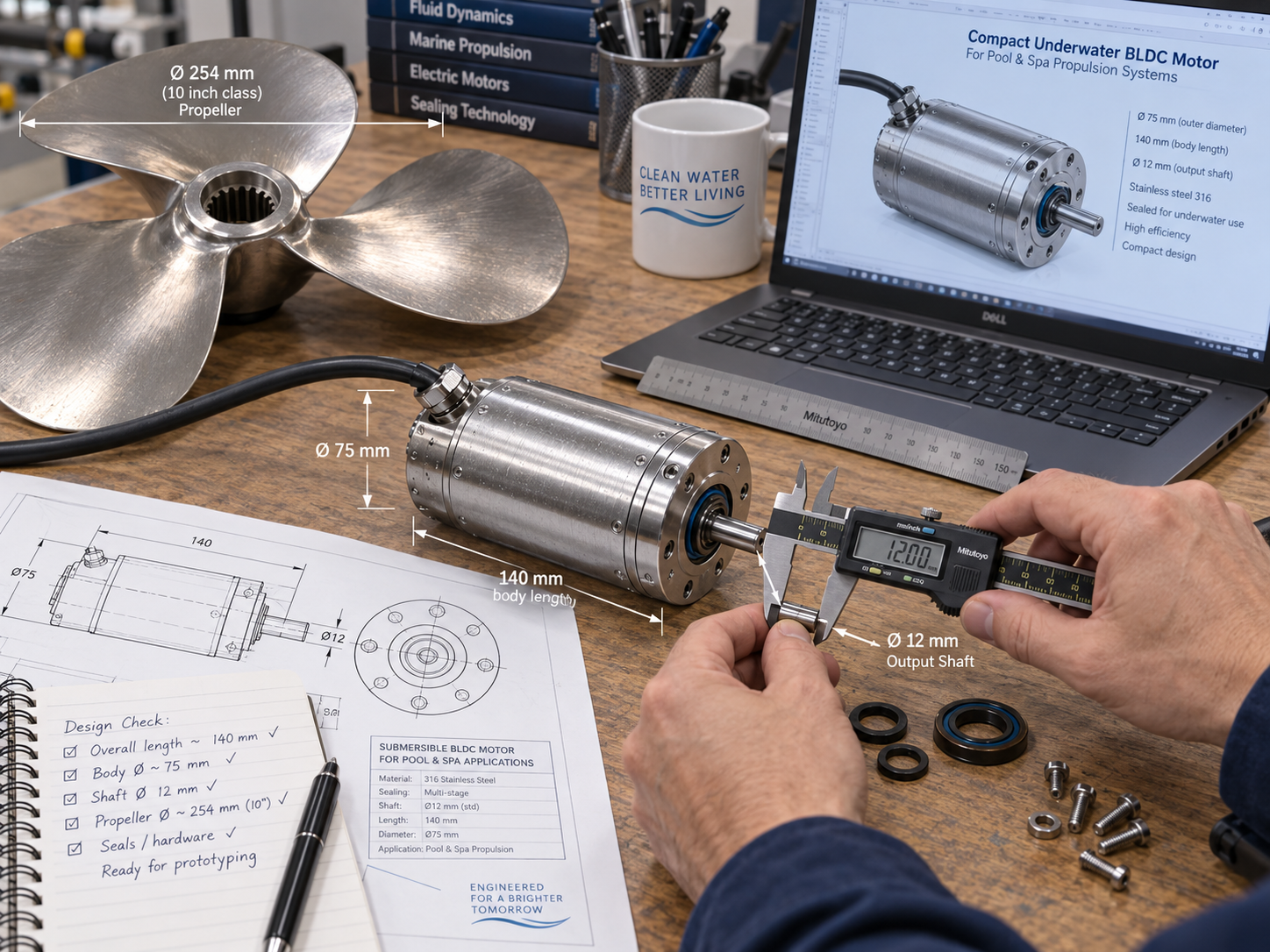
Step 3: Customize Only What Is Necessary
Depending on the project, changes may include:
- winding
- KV
- output shaft
- housing
- waterproof structure
- cable
- cable outlet direction
- mounting interface
Some projects need only one or two changes.
Others may need several.
Step 4: Build and Test the Prototype
The sample motor can then be checked for:
- RPM
- current
- motor temperature
- water-flow or propulsion performance
- waterproof performance
Once the motor works correctly in the actual equipment, the production specification can be finalized.
What Information Should You Send to a Submersible Motor Supplier?
You do not need a complete engineering package before making an enquiry.
For an initial review, these details are usually enough:
| Parameter | Useful Information |
|---|---|
| Application | Swim Spa / Pool Propulsion / Water Circulation |
| Voltage | 24V / 36V / 48V / Other |
| Power | 300W / 500W / 1kW / Other |
| Speed | Target RPM |
| Water Depth | Maximum operating depth |
| Water Type | Fresh / Chlorinated / Saltwater |
| Motor Size | Maximum diameter and length |
| Shaft | Diameter, length, thread or other interface |
| Propeller | Size or mounting method |
| Duty Cycle | Intermittent / Continuous |
| Quantity | Prototype quantity and estimated annual demand |
If you do not know all the parameters yet, start with what you have.
A motor photo, nameplate, drawing or equipment photo can often tell us a lot.
Frequently Asked Questions About Pool and Spa BLDC Motors
Can an IP68 BLDC motor be used in chlorinated pool water?
Potentially, yes, but IP68 alone is not enough to determine suitability.
The housing, shaft, fasteners and other exposed components should also be selected for the actual chlorine level, water temperature and expected service life.
Can I replace an existing brushed swim spa motor with BLDC?
In many cases, yes.
RPM, torque, shaft dimensions, controller requirements and installation size should be checked before selecting the replacement motor.
Where possible, the new BLDC motor can be customized to fit the existing equipment.
Can the motor shaft be customized for my existing propeller?
Yes. Shaft customization is common in OEM BLDC motor projects.
Diameter, length, thread, keyway, flat or D-cut geometry can often be modified to suit the existing propeller interface.
Do custom pool motors require new tooling?
Not necessarily.
If an existing motor platform is close to the required size and performance, the project may only require modifications to the shaft, winding, cable, housing or sealing structure.
A completely new design is normally considered only when the existing platforms are not suitable.
Can a submersible BLDC motor be designed for low-speed, high-torque operation?
Yes.
Motor winding, KV and controller configuration can be matched to a target RPM and torque range.
The final selection should also consider the actual propeller or impeller load.
Custom Submersible BLDC Motors for Pool and Spa Equipment
Choosing a motor for a pool or swim spa does not have to become a major engineering project.
For most OEM applications, we can begin with six practical questions:
Voltage & Power + RPM & Torque + Water Environment + Motor Size + Shaft Interface + Duty Cycle
From there, we can determine whether an existing BLDC platform can be used directly or adapted with a few targeted changes.
Typical customization includes:
- custom shaft
- winding and KV adjustment
- waterproof structure
- stainless steel housing
- cable configuration
- mounting interface
If you are developing or upgrading a:
- swim spa
- counter-current swimming system
- pool propulsion unit
- spa system
- underwater propulsion module
you can send us the existing motor specification, drawing or a few photos of the equipment.
You do not need to have every parameter finalized before contacting us.
We can first understand the application, identify the closest motor platform and work from there.