Inrunner vs outrunner motor — which design is better for your application? Whether you’re developing drones, robotic systems, industrial equipment, or custom electric drives, understanding the differences between these two BLDC motor types is essential for selecting the right solution.
In this guide, we compare seven important factors, including rotor structure, torque, speed, efficiency, cooling, size, and OEM applications.
Both motor types use electronic commutation and can deliver high efficiency, precise speed control, and long service life when properly designed. However, their mechanical structures create different advantages in torque production, rotational speed, thermal management, and installation.
So, which is better: an inrunner or an outrunner motor?
The answer depends on your application’s speed, torque, available space, cooling conditions, and mechanical requirements.
This guide explains the key differences and helps OEM engineers select a suitable motor architecture.
1. What Is an Inrunner BLDC Motor?
An inrunner BLDC motor has a rotating inner rotor surrounded by a stationary stator.
The permanent magnets are typically mounted on the inner rotor, while the copper windings are located in the surrounding stator.
When the motor controller energizes the stator windings, the resulting magnetic field drives the inner rotor.
Main Characteristics
- The rotor rotates inside the stator.
- The outer motor housing usually remains stationary.
- The motor can be designed for high rotational speeds.
- The relatively small rotor diameter can provide lower rotational inertia.
- Heat from the stator windings can often be conducted through the outer housing.
Inrunner motors are commonly used in high-speed industrial equipment, pumps, automated machinery, robotic actuators, and applications requiring compact cylindrical motors.
For example, an industrial drive requiring several thousand revolutions per minute may benefit from an inrunner architecture, depending on the required torque and cooling arrangement.
2. What Is an Outrunner BLDC Motor?
An outrunner BLDC motor places the stationary stator in the center, while the rotor rotates around its outside.
The permanent magnets are normally attached to the inside of the rotating outer shell.
This arrangement places the magnetic forces at a larger radius from the motor’s center.
Main Characteristics
- The external rotor rotates around the stationary stator.
- The larger rotor radius can help produce greater torque within certain size constraints.
- Outrunner designs are commonly used for direct-drive applications.
- The rotating outer shell generally has higher rotational inertia than a comparable small-diameter inner rotor.
- Mechanical mounting and cooling require attention because the outer rotor is moving.
Outrunner motors are widely used in multirotor drones, electric propulsion systems, fans, and some robotic and underwater applications.
For example, many multirotor drones use outrunner motors to drive their propellers directly without a gearbox.
However, not every outrunner motor is designed for low-speed operation, and actual performance depends on its electromagnetic and mechanical design.
3. Inrunner vs. Outrunner Motor: 7 Key Differences
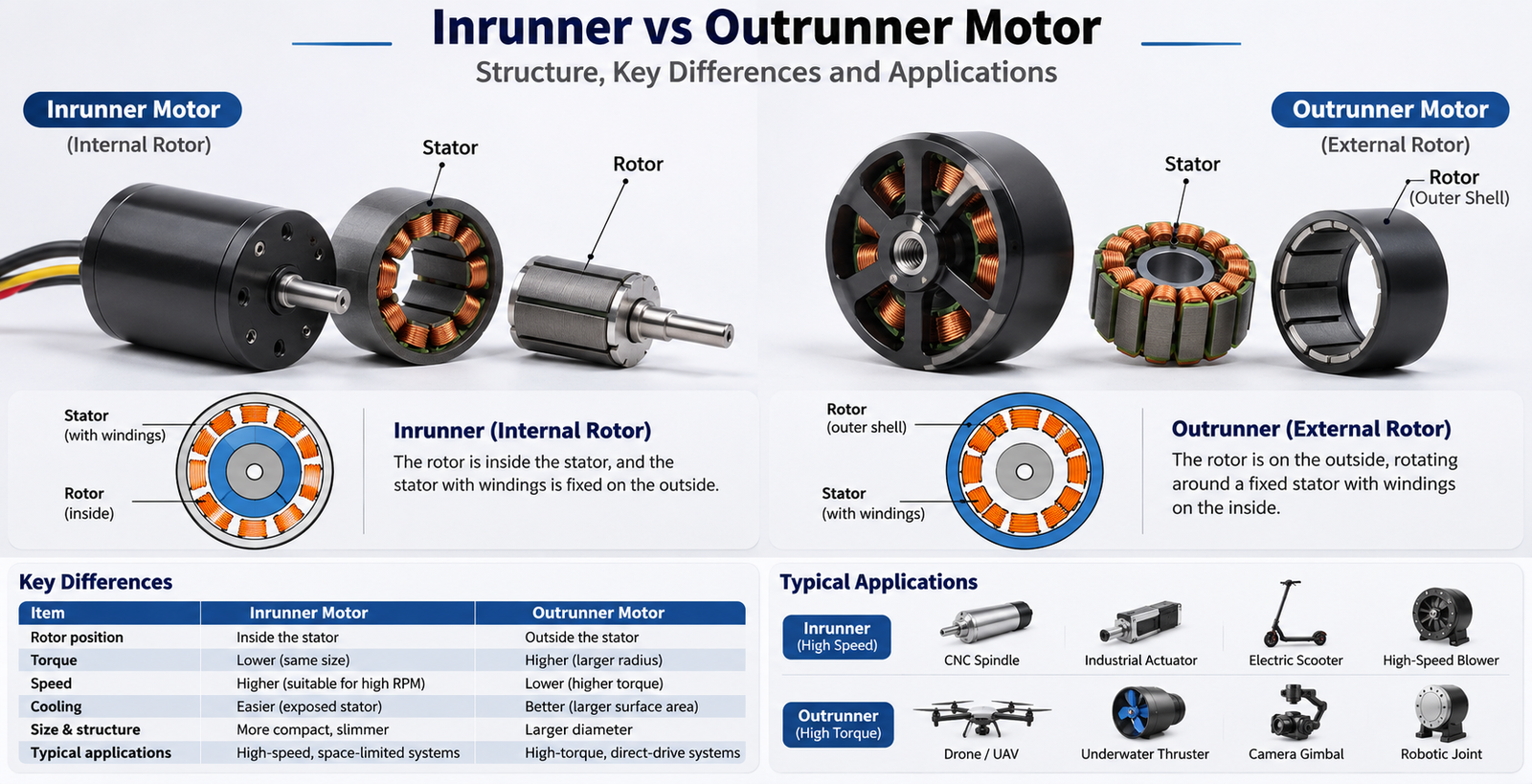
| Feature | Inrunner BLDC Motor | Outrunner BLDC Motor |
|---|---|---|
| Rotor position | Inside the stator | Outside the stator |
| Rotating component | Inner rotor | Outer shell or rotor |
| Typical design strength | High-speed capability | Torque-oriented direct drive |
| Rotor inertia | Often lower | Often higher |
| Thermal management | Stator heat can be transferred to the outer housing | Depends on internal heat paths and housing design |
| Mechanical arrangement | Convenient for conventional shaft-output systems | Suitable for direct-drive rotating assemblies |
| Common applications | Industrial drives, pumps, actuators | Drones, fans, propulsion systems |
These are general design characteristics, not universal performance rules.
A carefully designed outrunner can operate at high speed, while an inrunner can deliver substantial torque with an appropriate diameter, length, winding design, or gear reduction.
The final comparison must be based on actual motor specifications and operating conditions.
4. Which Motor Produces More Torque?
Outrunner motors are often associated with higher torque because their electromagnetic forces act at a larger radius.
For a given tangential force, a larger radius creates more torque.
This can be beneficial when driving a propeller or mechanical load directly.
However, rotor position alone does not determine torque.
Motor torque also depends on:
- Motor diameter and active length
- Magnet material and magnetic circuit
- Winding configuration and copper fill
- Current and thermal limits
- Pole count and electromagnetic design
A larger inrunner motor may produce more torque than a smaller outrunner.
For an OEM project, the correct comparison is the torque available at the required operating speed, including continuous thermal limits.
Peak torque alone is not sufficient for selecting a motor that must run continuously.
5. Which Motor Is Better for High Speed?
Inrunner motors are often preferred for high-speed applications because of their rotor geometry and relatively low rotational inertia.
A smaller rotor diameter can make it easier to manage certain mechanical stresses at high speed.
This makes inrunner motors attractive for high-speed pumps, precision equipment, and industrial machinery.
Outrunners are often selected where direct-drive torque and compact axial packaging are more important.
However, motor speed should not be determined simply by choosing one structure.
Engineers must also consider the motor’s KV rating, supply voltage, load torque, current limits, bearing system, and rotor mechanical strength.
KV indicates approximate no-load speed per volt, not the motor’s rated operating speed under load.
A motor with a higher KV is not automatically more powerful, and a lower-KV motor is not automatically suitable for every high-torque application.
6. Which Motor Is More Efficient?
Neither inrunner nor outrunner motors are inherently more efficient in every application.
Efficiency depends on several types of losses, including:
- Copper losses in the windings
- Magnetic and iron losses
- Bearing and mechanical losses
- Controller losses
- Additional losses associated with the operating environment
The same motor may operate efficiently at one speed and load but poorly at another.
Cooling also affects continuous performance. A motor capable of producing high peak power may need a substantially lower continuous power rating if heat cannot be removed effectively.
For engineering comparisons, manufacturers should provide efficiency data at relevant operating points rather than relying only on peak efficiency claims.
7. Which Motor Is Better for Different Applications?
Drone Motors
Outrunner BLDC motors are common in multirotor drones because they can provide suitable torque for directly driving propellers.
The selection should consider propeller size, battery voltage, required thrust, operating current, weight, and thermal performance.
Industrial Automation
Inrunner motors can be attractive for compact cylindrical installations and higher-speed machinery.
A gearbox may be added when the application requires lower output speed and higher output torque.
Outrunners can also be suitable for direct-drive industrial applications, depending on the system layout.
Robotic Actuators
Both designs can be used.
An actuator may prioritize torque density, position control, encoder integration, low backlash, or compact dimensions.
The motor architecture should be evaluated alongside the gearbox, controller, and mechanical assembly.
Underwater Propulsion
Both inrunner and outrunner motors can drive underwater propellers.
Outrunners are commonly found in compact direct-drive thrusters, while inrunners can be used in sealed or otherwise protected propulsion arrangements.
For underwater equipment, corrosion resistance, insulation, bearings, pressure tolerance, and motor cooling are often as important as rotor architecture.
For a more application-specific discussion, see our companion guide, Inrunner vs. Outrunner Motors for Underwater Thrusters: Which Should You Choose?
8. How to Choose the Right BLDC Motor for Your OEM Project
Before choosing between an inrunner and outrunner motor, define the actual operating requirements.
| Design Requirement | Information to Prepare |
|---|---|
| Supply voltage | Nominal and maximum operating voltage |
| Operating speed | Target RPM and allowable speed range |
| Torque | Continuous and peak torque |
| Power | Required mechanical output or electrical input |
| Dimensions | Maximum diameter, length, and shaft requirements |
| Duty cycle | Continuous, intermittent, or short-duration operation |
| Environment | Temperature, moisture, underwater exposure |
| Control | ESC or motor driver, feedback requirements |
| Production | Sample quantity and estimated annual volume |
The most effective motor selection begins with the load requirements, not simply an available motor diameter or KV rating.
If an existing motor does not meet the requirements, adjusting the winding, magnetic circuit, dimensions, or mechanical configuration may be necessary.
Such modifications must be evaluated and tested before performance can be confirmed.
9. Custom Inrunner and Outrunner BLDC Motor Manufacturing
For OEM equipment manufacturers, a standard catalog motor may not always fit the final product.
Applications may require special shaft dimensions, mounting interfaces, voltage ratings, speed characteristics, or environmental protection.
LETUMOTOR develops and manufactures brushless DC motors for industrial equipment, UAV applications, and underwater systems.
We support motor design evaluation and customization based on customer application requirements.
Our engineering team can review motor dimensions, operating conditions, performance targets, and production requirements to determine whether an existing motor platform or a custom design may be appropriate.
Performance, environmental protection, and compatibility must be confirmed through appropriate engineering evaluation and testing.
10. Frequently Asked Questions
Is an outrunner motor always more powerful than an inrunner?
No. Motor power depends on speed, torque, thermal limits, and electromagnetic design. Rotor configuration alone does not determine power output.
Why do many drones use outrunner motors?
Outrunners offer useful torque characteristics and packaging advantages for direct propeller drive. This can eliminate the need for a gearbox in many drone applications.
Are inrunner motors better for high RPM?
They are often advantageous for high-speed designs, but allowable RPM ultimately depends on rotor construction, bearings, mechanical stresses, and operating conditions.
Can both motor types be customized?
Yes. Depending on the manufacturer’s capabilities, both architectures can be customized for voltage, speed, dimensions, shaft configuration, and other application requirements.
Which motor is better for an underwater thruster?
Neither is universally better. The decision depends on propeller load, operating speed, required torque, exposure to water, pressure, cooling, and overall propulsion system design.
Conclusion
The main difference between inrunner and outrunner BLDC motors is the position of the rotating rotor.
Inrunners are often advantageous for high-speed applications and conventional shaft-output systems.
Outrunners are often attractive for compact direct-drive systems requiring suitable torque at the operating speed.
However, the best motor is not determined by structure alone. A successful OEM design requires the motor’s mechanical, electrical, and thermal characteristics to match the actual application.
Need a Custom Inrunner or Outrunner BLDC Motor?
LETUMOTOR supports custom BLDC motor development and manufacturing for OEM applications.
Send us your voltage, target speed, torque, dimensions, operating environment, and expected order quantity.
Our team can review your requirements and discuss a suitable motor solution.
Email: hello@letumotor.com